Example Report
Anhydrous Applications
John Lory and Peter Scharf, Plant Science Division
Farmers typically are anxious to get fall-applied anhydrous ammonia into the ground. Concerns about logistics and availability can pressure a farmer into moving up the date for application, a practice that increases the potential for over-winter loss of fertilizer nitrogen.
Many of you may be familiar with "50-degree" rule for anhydrous ammonia application. The old rule of thumb was that farmers in Northern Missouri should delay injection until average soil temperature at six inches was below 50 degrees F. We recently completed an evaluation of soil temperature data from across Missouri, Illinois and Iowa that indicates that farmers would benefit from delaying application until soils are cooler than 50 degrees F, particularly in Northern Missouri and Central Illinois.
The objective with fall-applied anhydrous ammonia is to apply into a cold soil to prevent the conversion of ammonium to nitrate. Injected anhydrous is attracted to soil particles preventing leaching losses. In warm soil anhydrous converts to nitrate, a form of nitrogen prone to leaching and denitrification. Soil temperature needs to be at or below freezing to fully eliminate conversion to nitrate.
The 50-degree rule comes from Minnesota, Iowa and other states farther north than Missouri. There are significant differences in over-winter soil temperature patterns in Northern Missouri compared to Iowa and Northern Illinois. We typically have warm weather at some time in January and February that allows soil temperature to rise well above freezing and soil temperatures rarely fall much below freezing. Farther north soil temperature frequently is below 32 degrees C and rarely rises above freezing. These warm weather events in winter make fall-applied nitrogen less stable in Missouri compared to our northern neighbors.
Northern Missouri farmers can compensate for some of the differences by delaying anhydrous ammonia injection until soil temperatures are cooler. Using a 40-degree rule compensates for many of the differences between central Iowa and Northern Missouri. The later you delay application the more likely the anhydrous will make it through the winter. Another approach to extending the application window is to add a nitrification inhibitor like N-Serve with your nitrogen fertilizer.
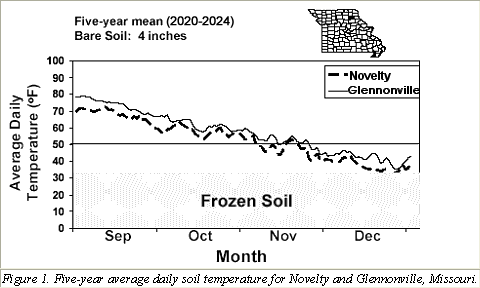
The down side to delaying application is that weather conditions can change making application difficult. Waiting for soil temperatures to approach 40 degrees F may delay application a month. In a typical year average six-inch soil temperature at Novelty Missouri reaches 50 degrees F around October 27th and 40 degrees F around November 24th.
Fall applied anhydrous ammonia is not considered a best management practice anywhere in Missouri. Preplant and sidedress applications are preferred because they minimize potential losses of applied nitrogen. If you choose to apply anhydrous ammonia in the fall, take steps to limit potential losses by delaying application until six-inch soil temperatures approach 40 degrees F and by using a nitrification inhibitor. Limiting fall anhydrous ammonia applications to less than half of planned corn and milo acres will also help to manage risk.
|